Why Kids Need Smart Phones
Every day we see more and more young children with access to smartphones. This constant exposure, practically starting from birth, will craft them into technological masters. They will be so in tune with their phones, computers, and tablets, that they will not be able to leave the virtual world. They will be able to do anything and everything they want, wherever and whenever they want. They wont even need the company of other people! They will already be experts on their friends lives through social media built into their devices. This generation of kids will be proof for the future that no amount of technological use is too much.
All over the country, astounding reports of technologically savy babies are making headlines. When babies cry, their parents have recently been consoling them with smartphones. As the babies grow up, they learn to navigate the phones. Before they can talk or even walk, babies can open phones, go to their favorite apps, and entertain themselves. This generation is obviously experiencing the technological revolution in education. While previous generations were stuck on square pegs and round holes, the smartphone generation is miles ahead. The technology is actually making them smarter. Soon, schools will be just a meeting place for students, as teachers will become obsolete. These super children will know exactly what to do and will do it without complaint, just because their smartphones told them to. It's almost the perfect system.
It is almost the perfect system because even this system has its problems. Why send the kids all the way to school? Thats a lot of hassle and wasted energy. Also, those other kids could be sick, dumb, or even dangerous non smartphoners from backwards stuckup families who think the old ways were better. The obvious solution is to let kids stay at home in their beds, woken up by their phones and ready to start school. They dont even need to move, spending all morning and afteroon learning form their best friend, their phone! "That's too much", you might say, and you are right, that is too much work. Waking up and doing things all day gets in the way of kids just being kids. Maybe the old ways are better. I propose the truly perfect solution.
When these babies are born, why give them smartphones when they could just become smartphones? Immediate, mandatory computer implatation. This way, kids could experience the world like they were meant to. Parents, if they so choose, could turn on location services and know where their kid is at any time of the day or night. Kids would no longer need school, they would just need to restart every night for about eight hours and update their brains with the knowlege alotted for that day. Over 18 years, kids would be given a basic set of skills in every field, and after that, they could choose what to download every night. If they wanted more data, all they would need to do is sleep longer. People would be left to enjoy their lives without the burden of forgetting things and looking at their phones. This is what society needs to strive for. This is what we are currently working towards. How long are we going to have to wait before our phones, our figurative babies, become our literal babies? That would sure make things easier.
Sunday, October 12, 2014

Editorial
Army Technology Saves Lives of Air Force Pilots
Many men and women owe their lives to a new technology researched by the United States military. Unmanned aerial vehicles (UAVs) are the most recent in a long line of groundbreaking technologies brought into the public eye by US military scientists. Inventions credited to them include GPS, the internet, duct tape, the microwave, and countless others. They ahve always invented amazing things, and then release them to the public who wait with open arms. Sometimes their inventions are criticized by the media, even though they are productive. UAVs have come under heavy fire recently by some liberal politicians for their drastic missions. They are innovative technologies and should be utilized to their full potential.
These drones were made to keep pilots safe. In the military, the term "boots on the ground" is often used to classify offensives in other countries. If the situation gets to the point where American "boots" have to make contact with foreign "ground", the public is usually informed and becomes opinionated. Boots being on the ground usually means that there is a high possibility of death for boot wearers. The step before boots on the ground combat is usually "boots in the sky". This refers to American piloted planes performing combat missions over foreign ground. Wearers of sky boots often have a much higher survival rate that ground boot wearers. None the less, there is a very real possibility of American death where skybooting is concerned. With the UAVs, American boots could end their relationship with foreign ground almost entirely. They allow pilots to fly planes remotely from a secure command center, possibly in The United States. By preventing the need for Americans in combat zones, UAVs have the potential to save countless lives if fully implimented.
In addition to saving American lives, UAVs are shown to prevent enemy civilian casualties. In the second world war, many of the tactics used were centered around maximizing civilian deaths. Governments thought their opponents would back down if enough of their civilians were killed. This tactic did not prove to be the most successful and ever since then, in fear of the media, politicians and officers try to put together plans to minimize death of innocents. In recent efforts, they have turned to the precision and speed of UAVs. They provide the US with a way to infiltrate enemy territory, and concetrate efforts where they are needed the most. UAVs can be outfitted with various types of weapons, enabling them carry out a diverse set of missions. They are great for reconaissance missions, being less expensive to fly than fighter jets, and able to fly longer, up to 27 hours. In 2013, UAV missions had a civilian casualty rate of only 30%, meaning that 7 out of every ten people killed were enemy leaders. This is much better than the fighter jet ratio and was carried out faster. While UAVs are a better alternatives for the US in the ever-changing combat world, they are also better for those who want to stay out of combat in their homeland.
Those against the use of UAVs have two main claims. The first is that UAVs violate international law. They claim the United Nations charter states that a country can not use lethal force on another without mutual consent, usually during war. Our use of these weapons without the consent of the countries in which we are usimg them, viotlates this law. Their claim comes from a misinterpretation of the law. The people who we are trying to stop are not from a country, they are from a terrorist organization. Therefore, this law does not apply in the case of the US using UAVs to strike threats. The other claim is that the missions carried out by UAVs are secretive, and their information is not released to the public. At first glance this may sound legitimate, but on further inspection, its absurdity is obvious. If the military were to give the information of all its missions and their results out to the public, how would they keep secrets from their enemies? Until the situation is resolved, it is necessary to maintain a degree of secrecy. Without it, the enemies would continue to stay one step ahead of us, and the conflicts would never end.
UAVs have many uses on and off the battle field. Banning them altogether would eliminate any good they are currently doing. Regulating them and requiring military transparency would be even worse. The best option is to stay the course. The opposition to the current system has brought no concrete evidence to show its problems. All they can do is speculate while hard working men and women are getting results.
Many men and women owe their lives to a new technology researched by the United States military. Unmanned aerial vehicles (UAVs) are the most recent in a long line of groundbreaking technologies brought into the public eye by US military scientists. Inventions credited to them include GPS, the internet, duct tape, the microwave, and countless others. They ahve always invented amazing things, and then release them to the public who wait with open arms. Sometimes their inventions are criticized by the media, even though they are productive. UAVs have come under heavy fire recently by some liberal politicians for their drastic missions. They are innovative technologies and should be utilized to their full potential.
These drones were made to keep pilots safe. In the military, the term "boots on the ground" is often used to classify offensives in other countries. If the situation gets to the point where American "boots" have to make contact with foreign "ground", the public is usually informed and becomes opinionated. Boots being on the ground usually means that there is a high possibility of death for boot wearers. The step before boots on the ground combat is usually "boots in the sky". This refers to American piloted planes performing combat missions over foreign ground. Wearers of sky boots often have a much higher survival rate that ground boot wearers. None the less, there is a very real possibility of American death where skybooting is concerned. With the UAVs, American boots could end their relationship with foreign ground almost entirely. They allow pilots to fly planes remotely from a secure command center, possibly in The United States. By preventing the need for Americans in combat zones, UAVs have the potential to save countless lives if fully implimented.
In addition to saving American lives, UAVs are shown to prevent enemy civilian casualties. In the second world war, many of the tactics used were centered around maximizing civilian deaths. Governments thought their opponents would back down if enough of their civilians were killed. This tactic did not prove to be the most successful and ever since then, in fear of the media, politicians and officers try to put together plans to minimize death of innocents. In recent efforts, they have turned to the precision and speed of UAVs. They provide the US with a way to infiltrate enemy territory, and concetrate efforts where they are needed the most. UAVs can be outfitted with various types of weapons, enabling them carry out a diverse set of missions. They are great for reconaissance missions, being less expensive to fly than fighter jets, and able to fly longer, up to 27 hours. In 2013, UAV missions had a civilian casualty rate of only 30%, meaning that 7 out of every ten people killed were enemy leaders. This is much better than the fighter jet ratio and was carried out faster. While UAVs are a better alternatives for the US in the ever-changing combat world, they are also better for those who want to stay out of combat in their homeland.
Those against the use of UAVs have two main claims. The first is that UAVs violate international law. They claim the United Nations charter states that a country can not use lethal force on another without mutual consent, usually during war. Our use of these weapons without the consent of the countries in which we are usimg them, viotlates this law. Their claim comes from a misinterpretation of the law. The people who we are trying to stop are not from a country, they are from a terrorist organization. Therefore, this law does not apply in the case of the US using UAVs to strike threats. The other claim is that the missions carried out by UAVs are secretive, and their information is not released to the public. At first glance this may sound legitimate, but on further inspection, its absurdity is obvious. If the military were to give the information of all its missions and their results out to the public, how would they keep secrets from their enemies? Until the situation is resolved, it is necessary to maintain a degree of secrecy. Without it, the enemies would continue to stay one step ahead of us, and the conflicts would never end.
UAVs have many uses on and off the battle field. Banning them altogether would eliminate any good they are currently doing. Regulating them and requiring military transparency would be even worse. The best option is to stay the course. The opposition to the current system has brought no concrete evidence to show its problems. All they can do is speculate while hard working men and women are getting results.
Thursday, October 9, 2014
Article
Article:
http://www.computerworld.com/article/2593079/ubiquitous--pervasive--sorry--they-don-t-compute.html

Picture
http://designingforusabilitybendavis.blogspot.com/2008/10/studio-1-definitions-and-images-of.html
This article gives two possible pathways that our current technology could take into the future. The author explains the similarities and differences of the two in order to clear up confusion about what their names mean. The first option the article describes is pervasive computing. The article defines pervasive as "diffused throughout every part of". It uses this definition to explain that pervasive computing is a future where we see technology everywhere. Free computer kiosks dot sidewalks and stores, and people use their handheld devices for everything and anything they can. The other, very similar, option is referred to as ubiquitous computing. Defined as "everywhere", the word ubiquitous shows the reader that this future of technology is much smoother. Instead of technology in every part of our lives, technology is so ingrained in our routines that it almost ceases to exist. It does everything for us even before we tell it too. From GPS units that alert us of upcoming traffic to ovens that turn themselves off when we forget, ubiquitous computing is almost like invisible technology, running thousands of calculations per second to improve our lives.
This topic of future technology interests me very much. I like the way this author defines the two very similar terms, and shows the large difference in the simple definitions. The two terms are often used interchangeably, which I now know is false. The two terms are very related, but almost are sequential and dependent on each other. I don't think that we could ever reach ubiquitous computing without first enduring pervasive computing. There will be a time where almost everyone in the first world is glued to little screens on their wrists and palms. Soon after people will realize that technology should be working for us instead of the other way around. People will move technology out of the spotlight, without losing any of it's benefits, and focus on each other.
I think that this author is biased to the idea of ubiquitous computing. He defines two terms, then uses his own definitions to compare them. He selects many positive pieces of evidence to support the ubiquitous side while omitting almost all negatives. He does the opposite for pervasive computing, almost making fun of the people who support it. Near the end of the article, the author uses a quote from an expert about the difference between the two. The man he quotes is the man who invented and is researching ubiquitous computing. The quote is most likely bias due to its source. The author has one more interesting bias. The article was written in March 2000. It is interesting to read the article considering all the technological progress we have made since then, If the article is reread with this bias in mind, it may come across a little differently. Although there is bias, I don't think it is strong enough for this to be considered an editorial.
http://www.computerworld.com/article/2593079/ubiquitous--pervasive--sorry--they-don-t-compute.html
Picture
http://designingforusabilitybendavis.blogspot.com/2008/10/studio-1-definitions-and-images-of.html
This article gives two possible pathways that our current technology could take into the future. The author explains the similarities and differences of the two in order to clear up confusion about what their names mean. The first option the article describes is pervasive computing. The article defines pervasive as "diffused throughout every part of". It uses this definition to explain that pervasive computing is a future where we see technology everywhere. Free computer kiosks dot sidewalks and stores, and people use their handheld devices for everything and anything they can. The other, very similar, option is referred to as ubiquitous computing. Defined as "everywhere", the word ubiquitous shows the reader that this future of technology is much smoother. Instead of technology in every part of our lives, technology is so ingrained in our routines that it almost ceases to exist. It does everything for us even before we tell it too. From GPS units that alert us of upcoming traffic to ovens that turn themselves off when we forget, ubiquitous computing is almost like invisible technology, running thousands of calculations per second to improve our lives.
This topic of future technology interests me very much. I like the way this author defines the two very similar terms, and shows the large difference in the simple definitions. The two terms are often used interchangeably, which I now know is false. The two terms are very related, but almost are sequential and dependent on each other. I don't think that we could ever reach ubiquitous computing without first enduring pervasive computing. There will be a time where almost everyone in the first world is glued to little screens on their wrists and palms. Soon after people will realize that technology should be working for us instead of the other way around. People will move technology out of the spotlight, without losing any of it's benefits, and focus on each other.
I think that this author is biased to the idea of ubiquitous computing. He defines two terms, then uses his own definitions to compare them. He selects many positive pieces of evidence to support the ubiquitous side while omitting almost all negatives. He does the opposite for pervasive computing, almost making fun of the people who support it. Near the end of the article, the author uses a quote from an expert about the difference between the two. The man he quotes is the man who invented and is researching ubiquitous computing. The quote is most likely bias due to its source. The author has one more interesting bias. The article was written in March 2000. It is interesting to read the article considering all the technological progress we have made since then, If the article is reread with this bias in mind, it may come across a little differently. Although there is bias, I don't think it is strong enough for this to be considered an editorial.
Editorial Cartoon
Editorial Cartoon:
http://thecomicnews.com/edtoons/archive/2009/0722/technology/03.php
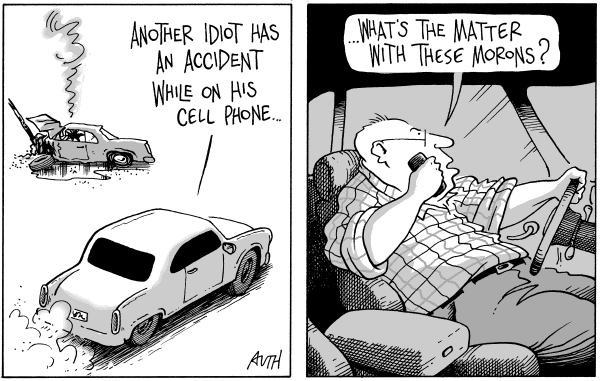
This cartoon brings up one of the dangers of technology. I refer to it as "disctracted verbing". It often takes the forms of distracted driving or distracted listening. It has many other forms such as distracted talking, sleeping, and even eating. Everyone says that distracted verbing is dumb, and complain about those who do it. This is often hypocritical because everyone has the urge to do it. Cutting unnecessary electronic time out of our lives is much easier said than done. You can even show people that what they are doing is life-threatening, and they will continue to go on doing it. It hasn't caught up with them yet, so they have no reason to believe it ever will.
I think this cartoon is effective at getting it's point across. It uses two frames to form a simple case of situational irony. The same point could have been made in one frame, but the author used two to throw the reader off track. By drawing the outside of the car in the first frame, the cartoonist makes the reader assume that the person in the moving car is not talking on a cell phone. This is done by the phrasing of the words above the moving car. When it is revealed in the second frame that the man in the moving car is on a cell phone, the reader laughs, because he contradicts himself, and the reader did not see it coming. It concisely shows what the cartoonist thinks about the topic in a humorous way. Also on the inside of the car, it is obvious that the driver is an older man who is slouched in his chair. He gives the impression of insensitivity just from the way he sits and his facial expression. The only thing I think it lacks is power. I think it needs to be a little more serious with regards to the fact that the person died from cell phone usage. As is, it just sort of makes me laugh and move on. To really change people's mind, there needs to be a serious twist at the beginning or end. This would make the driver's comment sobering, and meaningful. If the cartoonist's goal was just to make people laugh about the hypocrisy of the every day man, then he did a good job.
http://thecomicnews.com/edtoons/archive/2009/0722/technology/03.php
This cartoon brings up one of the dangers of technology. I refer to it as "disctracted verbing". It often takes the forms of distracted driving or distracted listening. It has many other forms such as distracted talking, sleeping, and even eating. Everyone says that distracted verbing is dumb, and complain about those who do it. This is often hypocritical because everyone has the urge to do it. Cutting unnecessary electronic time out of our lives is much easier said than done. You can even show people that what they are doing is life-threatening, and they will continue to go on doing it. It hasn't caught up with them yet, so they have no reason to believe it ever will.
I think this cartoon is effective at getting it's point across. It uses two frames to form a simple case of situational irony. The same point could have been made in one frame, but the author used two to throw the reader off track. By drawing the outside of the car in the first frame, the cartoonist makes the reader assume that the person in the moving car is not talking on a cell phone. This is done by the phrasing of the words above the moving car. When it is revealed in the second frame that the man in the moving car is on a cell phone, the reader laughs, because he contradicts himself, and the reader did not see it coming. It concisely shows what the cartoonist thinks about the topic in a humorous way. Also on the inside of the car, it is obvious that the driver is an older man who is slouched in his chair. He gives the impression of insensitivity just from the way he sits and his facial expression. The only thing I think it lacks is power. I think it needs to be a little more serious with regards to the fact that the person died from cell phone usage. As is, it just sort of makes me laugh and move on. To really change people's mind, there needs to be a serious twist at the beginning or end. This would make the driver's comment sobering, and meaningful. If the cartoonist's goal was just to make people laugh about the hypocrisy of the every day man, then he did a good job.
Subscribe to:
Comments (Atom)